
It is past nine o'clock on a weeknight in Butte, Montana, and the word "Chop Suey" is glowing in red neon above Main Street. It has been glowing, more or less continuously, since 1911. The copper mines are gone. The population has dropped from 100,000 to 34,000. Four generations of the Tam family have passed through the kitchen below that sign. The fifth generation is still there.
The Pekin Noodle Parlor is the oldest continuously family-owned Chinese restaurant in the United States. Most people outside Butte have never heard of it. That, in a sense, is the point.
The Pattern
There are roughly 45,000 Chinese restaurants operating in the United States — more than McDonald's, Burger King, and Wendy's combined. That number gets cited in food journalism as a kind of cultural parlor trick. The part that gets less attention is the distribution. Chinese restaurants aren't clustered in Chinatowns or coastal cities. They're in Kanab, Utah (population 4,200), between two national parks. They're in Pinedale, Wyoming (population 2,000), where the main economic activity is natural gas extraction. They're in towns in Saskatchewan where the restaurant owner was, for years, the only Chinese person within fifty miles.
The 1931 Canadian census found that one in five restaurant and café owners in Saskatchewan was Chinese — this in a country where Chinese immigrants were less than one percent of the population. A similar pattern held across remote American states. The math doesn't make sense until you understand the conditions that created it.
The Chinese Exclusion Act of 1882 and its successors made most American occupations legally inaccessible to Chinese immigrants. The exceptions were laundries and restaurants: businesses that required no license, no credentials, and could be operated by a family unit without fluent English. The menu could be translated; the food crossed language barriers without much help.
But why the remote towns specifically? Partly because the competition was lower. Partly because economic survival in an isolated community is more forgiving than competing in a city where every conceivable ethnic food already has a dozen established operators. And partly because the mining towns and frontier outposts that couldn't attract other businesses were the places where an immigrant family, willing to work seven days a week, could build something that lasted.
They stayed. The towns changed around them. The restaurants remained.
Butte, Montana: 113 Years and Counting
The Pekin Noodle Parlor opened in 1911 when Butte was a boomtown — one of the largest cities west of the Mississippi, its streets lit by copper-funded electricity and its population swelled by immigrants from a dozen countries, including China. The Tam family arrived with that wave. They haven't left.
Jerry Tam, the fifth-generation owner, runs the restaurant with a deliberateness that comes from understanding what he's holding. The dining room retains its original wooden booths. The basement is a time capsule of the family's first century in America: handwritten ledgers, old menus in English and Chinese, family photographs spanning five generations. A local archives exhibit documents it as "One Family — One Hundred Years."
The copper industry collapsed. Other businesses closed. The Tams kept cooking. There is something almost geological about the Pekin Noodle Parlor — it has become part of the landscape of Butte itself, a fixed point that people orient themselves by. Visitors who moved away decades ago come back with their grandchildren and order the same things their own grandparents ordered.
What the archives don't quite capture is what it costs to hold that kind of continuity. Five generations is not just time — it's the accumulated decision, made over and over by each generation, not to leave.
The Arctic: Where the Map Runs Out
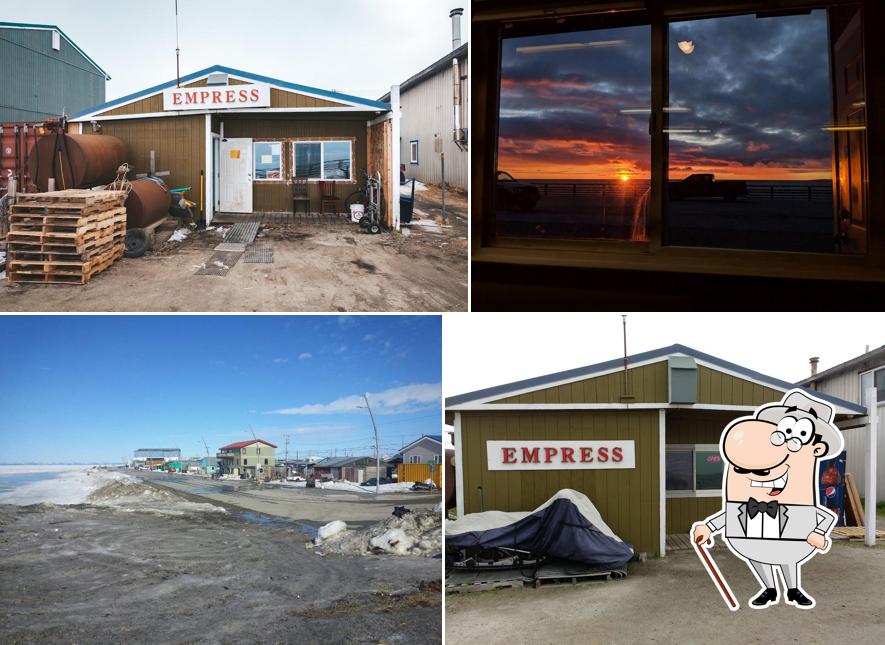
Empress Chinese Restaurant, 26 miles above the Arctic Circle. The menu includes reindeer fried rice.
Drive north from Fairbanks and eventually the roads stop. Beyond that point, Alaska is only accessible by bush plane. The town of Kotzebue sits 26 miles north of the Arctic Circle, connected to the outside world by scheduled flights and a waterfront that looks out toward the Chukchi Sea.
The Empress Chinese Restaurant has been feeding Kotzebue for decades. Its menu includes Chinese staples and something you won't find anywhere south of the tree line: reindeer fried rice. Local ingredients, Chinese technique — the fusion that happens naturally when a family plants itself somewhere long enough to absorb the place. The restaurant sits on the waterfront, mountains in the middle distance, the ocean somewhere beyond. The juxtaposition is not lost on anyone who eats there.
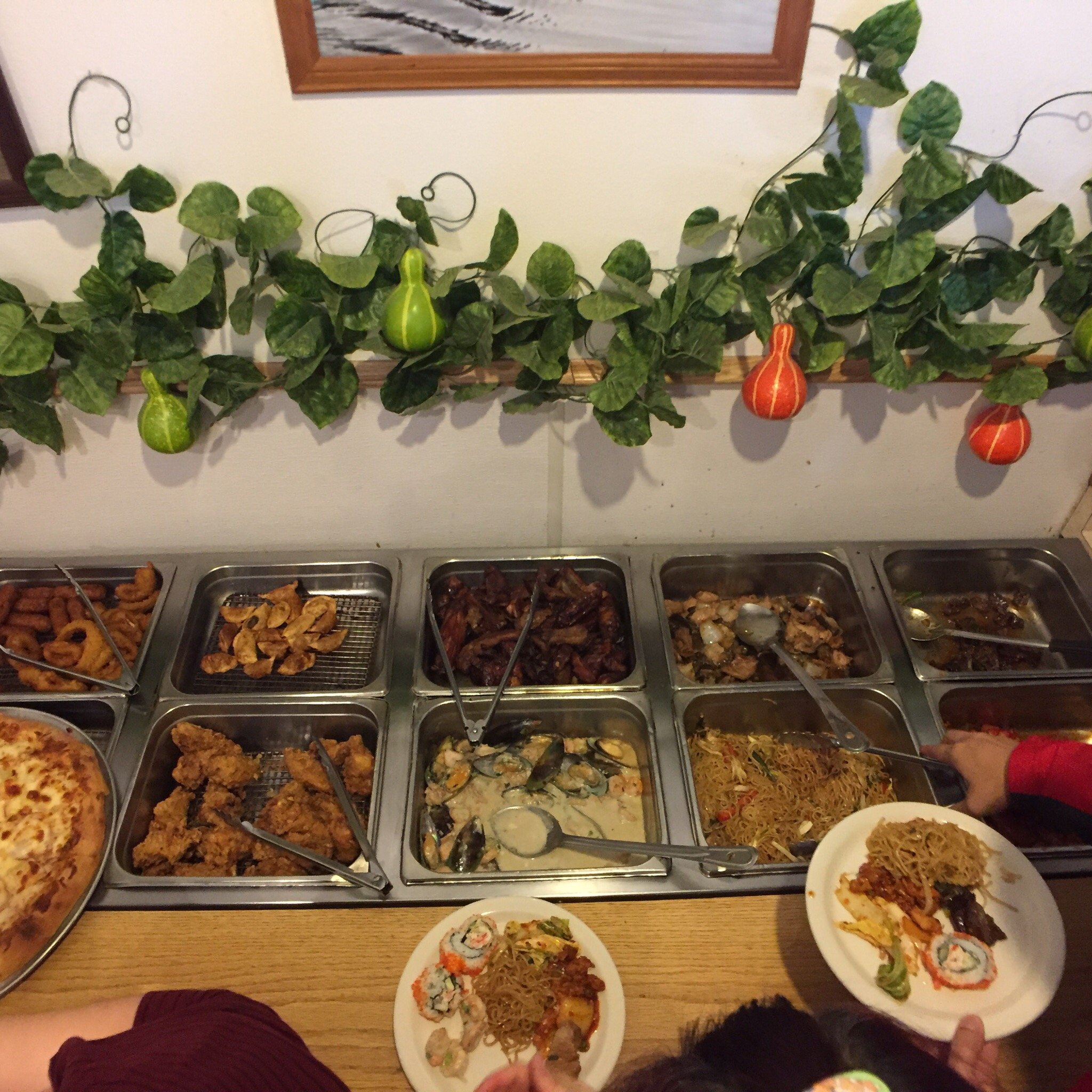
Sam & Lee's Restaurant. The sun doesn't rise here from November to January.
Continue north by another four hundred miles and you reach Utqiaġvik — formerly Barrow — at latitude 71°N. Sam & Lee's Restaurant sits at what may be the northernmost Chinese restaurant in the United States. The sun doesn't set from May to August. It doesn't rise from November to January. The clientele is a mix of oil industry workers and Ińupiat families. The table condiments run to soy sauce, sugar packets, and non-dairy creamer. The kitchen serves Korean-Chinese-Alaskan dishes that exist nowhere else in the world.
There is something almost philosophical about ordering fried rice at 71° north, with the Arctic Ocean a few miles away. The fact of the restaurant is itself an argument — that the impulse to cook and eat together, and the economic logic that makes a family restaurant viable in a particular place, operates independently of weather, remoteness, or how far you are from anywhere else.
The International Pattern
The phenomenon doesn't stop at American or Canadian borders.
In Reykjavik, a restaurant called Fine — the Chinese character on its sign means rice, a word that doubles here as a metaphor — has been operating for years. The owner, Liu, moved to Iceland from China seventeen years ago, settling 9,000 kilometers from his hometown. He makes dim sum by hand. His kitchen uses Icelandic lamb with Chinese spice combinations that have no precise name because they were invented in this specific place, for this specific climate. The result is a menu that couldn't exist anywhere else on earth.
In Patagonia, a couple from Fujian Province has been running what is believed to be the only Chinese restaurant in their region of Argentina for over twenty years. In rural Australia, a 2024 documentary series spent six episodes following Chinese restaurant families in small regional towns — towns where, as one local put it, "every town has a Chinese restaurant" had simply become a fact of the landscape. In Saskatchewan, families like the Liangs ran the only restaurant in towns of 400 people and were, as one family member recalled, simply "the only Chinese people in town."
The specifics vary by continent. The structure is the same everywhere: an immigrant family finds a remote community where no one else wants to open a restaurant, and they open one. Then they stay.
What Gets Lost
The generation that built these restaurants — the ones who arrived with limited English, learned the specific tastes of a specific remote town, and stayed through economic cycles that destroyed every other business around them — is aging out. Their children, in most cases, have left for cities and professions. This is not a tragedy. It is what upward mobility looks like.
But when the last family-run Chinese restaurant closes in a town of 300 people in the Alaskan interior, something specific and irreplaceable closes with it. Not just the food. The forty-year relationship between a family and a place. The fact that the restaurant was, for a long time, the only sit-down dining within a hundred miles. The way that fact shaped both the community and the family that served it.
The restaurants that remain are not anachronisms. They are among the oldest continuously operating businesses in their towns. The Pekin Noodle Parlor has outlasted the copper industry that built Butte. Remote Alaska's Chinese restaurants have outlasted the oil booms that brought their earliest customers. They are, in the most practical sense, part of the infrastructure of places that have almost no infrastructure left.
The neon above the Pekin Noodle Parlor will go off someday. There is no fifth-generation guarantee of a sixth. The same is true of Sam & Lee's, of the Empress, of dozens of restaurants like them scattered across the far reaches of the continent and beyond.
We're documenting them before it does.
The book is coming.
Large-format photography and oral histories from the families behind these restaurants. Get notified when it's available.
Field updates. No spam. Unsubscribe anytime.